
Getting comfortable
Being curious about why men seem to not practise mindfulness, I set out to find the profile of men who do practise, and compare it with those who don’t.
The discussion below insights into the results of the survey – in-sight, a turning inwards – into the psyche of men, rooted in depth and archetypal psychotherapies.
“Reflexio is a turning inwards… there ensues a succession of derivative contents or states which may be termed reflection or deliberation.
Carl Jung, CW 8 [241–43]
Through the reflective instinct, the stimulus is more or less wholly transformed into a psychic content, that is, it becomes an experience …”
Jung might easily have been describing the practice of mindfulness as a turning inwards. Let’s do just that…
Focussed Attention
The first notable point is that there were no responses of yes to practising mindfulness from the 43-49 year olds.
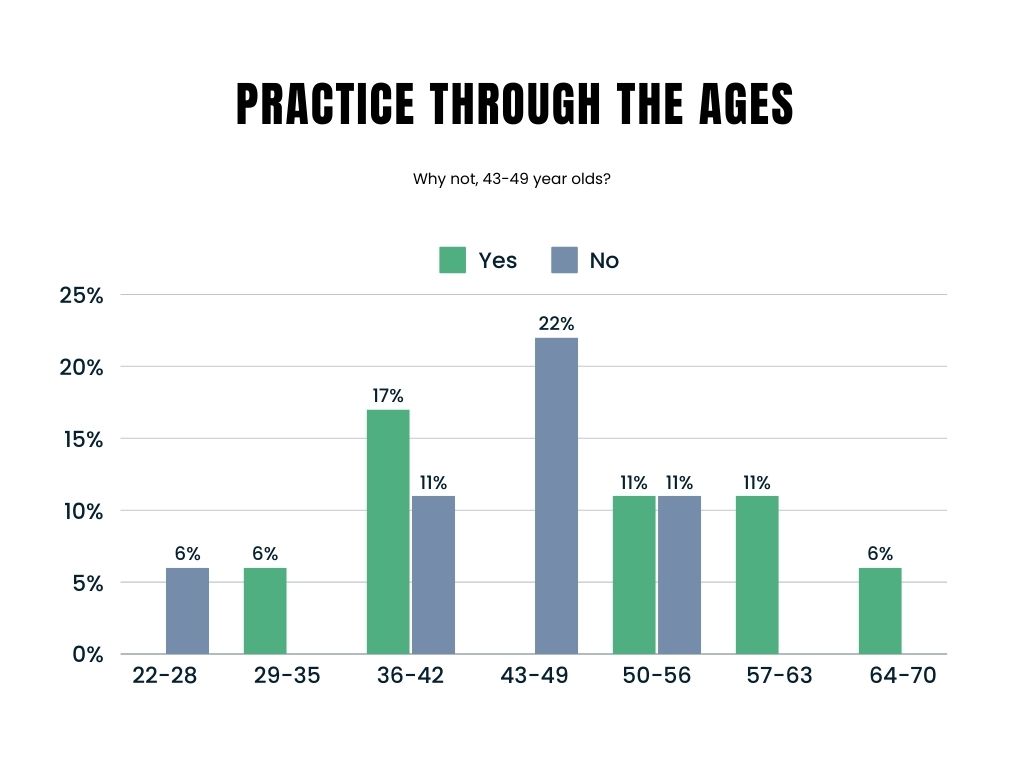
This ‘middle-aged’ band can be recognised in men as a time of turmoil and confusion, as a man’s life turns to old age, and inevitably, death.
No surprise then that all responses from 57 onwards are yes to mindful practice, indicative of the reflective instinct.
Looking at the responses to What defines you as a man, it seems that mindful practitioners have a range of experiences that arrive as a definition which extend beyond those who don’t practise.
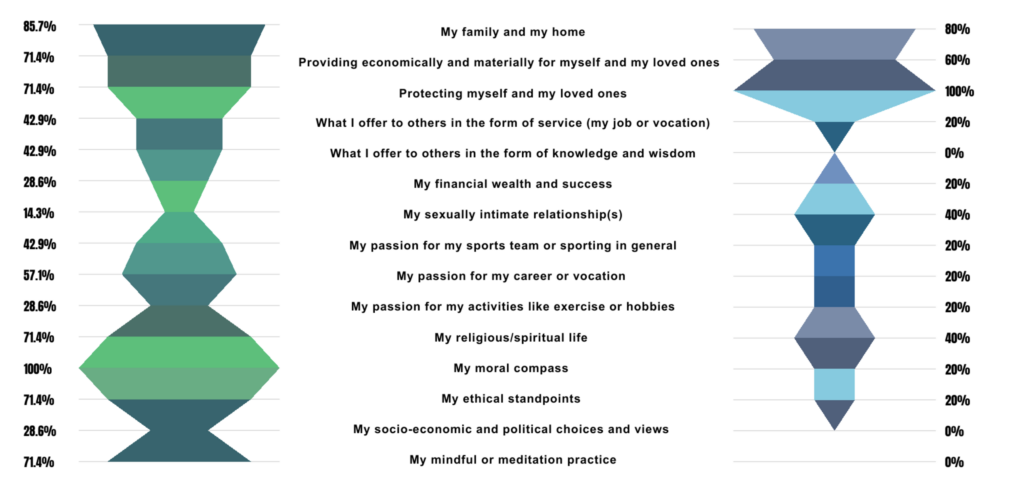
The more crucial aspects of this are the moral, ethical, and sexual intimacy factors.
Men who don’t practise mindfulness seem to define themselves more in relation to their sexual intimacy. So, does mindfulness reduce intimacy? Or, put another way, in how many other areas of life could men have an eros (energy, desire, libido – a broad life-affirming feeling toward connection and meaning)? Mindfulness seems to deepen men’s intrapsychic experiences, broaden their views to what archetypal psychology calls a soul’s perspective. That would allow for eros to be found in more than sexual intimacy.
For example, it can also be found in men’s attitudes on their morality and ethics – the set of principles guiding how these men live their lives – which appears higher for men who practise mindfulness.
“…we might regard ego from soul’s perspective where ego becomes an instrument for day-to-day coping, nothing more grandiose than a trusty janitor of the planetary houses, a servant of soul-making.”
Hillman, James; Jung, C.G.., Anima: Anatomy of a Personified Notion
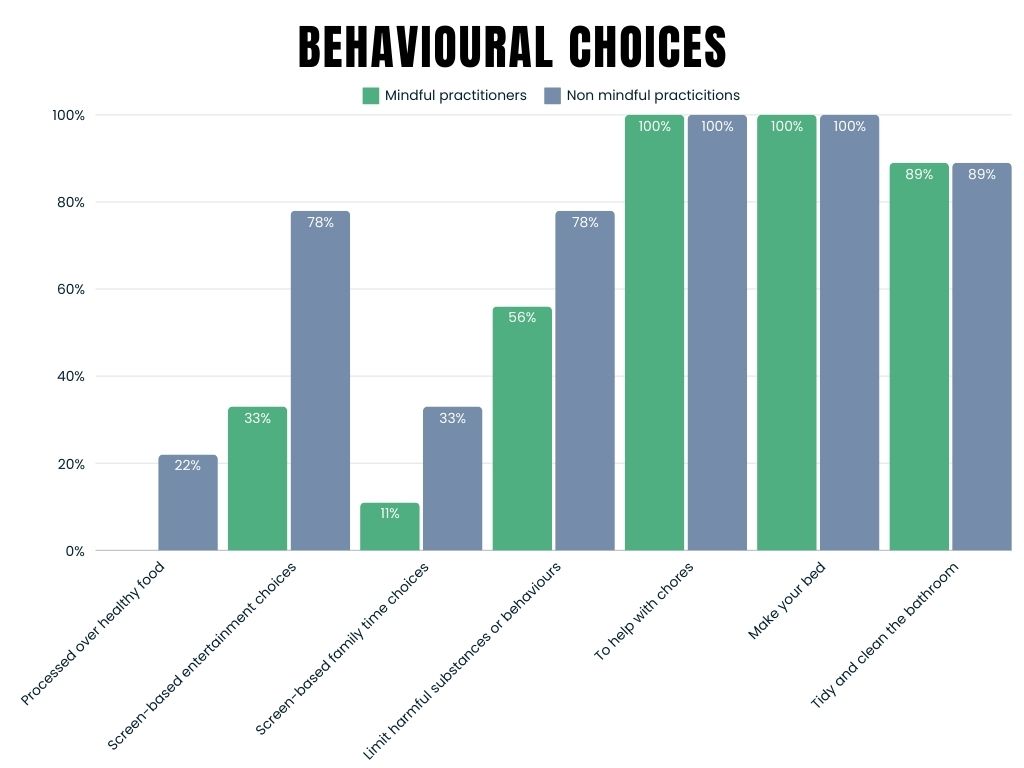
What is surely comforting at the very least from this survey – is that all men, regardless of their mindful practice, help at home and make their beds! Perhaps parental influences have filtered through there.
Many of us who find our middle age in this digital era have a harder choice on whether to consume processed food and entertainment. And this is only going to get more difficult as the attention industry continues its march, and screens become more ubiquitous in the home and the hand.
Mindful practices can lead to healthier choices, and even when a man chooses a harmful substance as 56% of mindful practitioners do, it could be done with more awareness of the act and its impact on wellness.
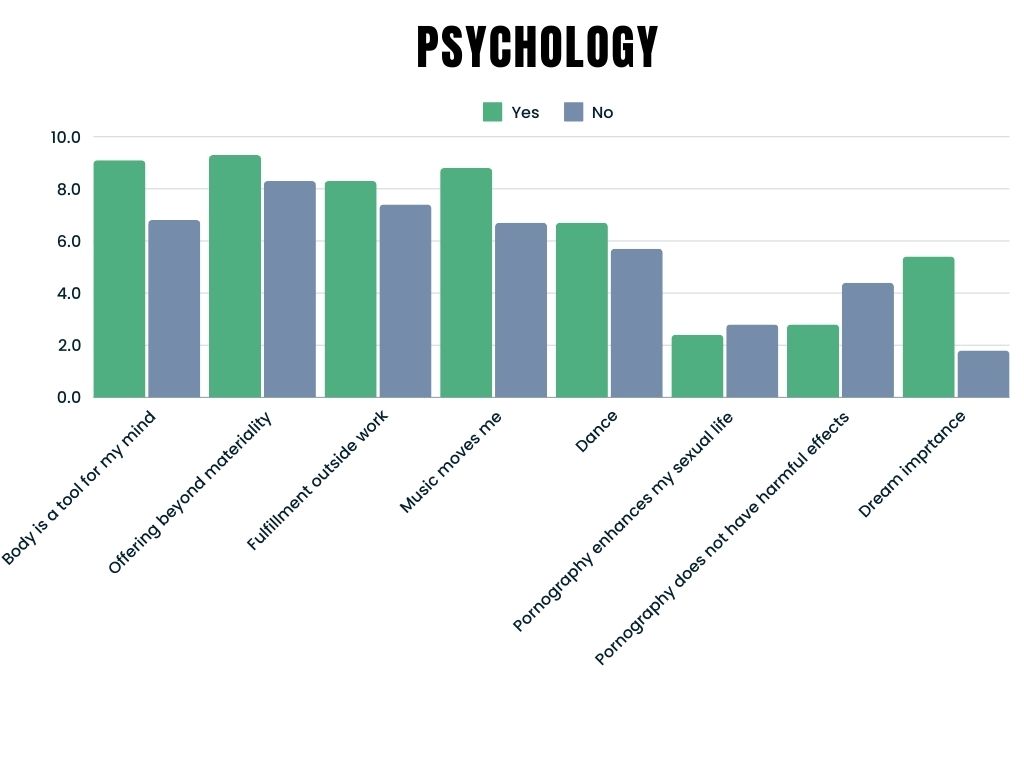
As a man develops his mindful practice, including attitudes of non-striving, non-judgmentalism, responsiveness and open-heartedness (for more please see Jon Kabat-Zinn’s work), his consciousness can shift to non-objective reality – reality beyond our direct experience.
That practitioners are moved more than non-practitioners by music and dance, shows a willingness to allow a surrender into something other which moves a person, something that is not goal-oriented, linear thinking. Similarly, the importance of dreams is heightened which – as music is heard – is seen by an eye which is not physical, and experienced in a realm which is not in the waking ego’s reality. This shows as one the benefits of mindful practice, the ability to relax our need to control our world, allowing deeper energy to surface.
“if we shift our conception of the base of consciousness from ego to anima archetype, from I to soul… Then one realizes from the very beginning (a priori and by definition) that the ego and all its developmental fantasies were never, even at the start, the fundament of consciousness, because consciousness refers to a process more to do with images than will, with reflection rather than control, with reflective insight into, rather than manipulation of, “objective reality.”
Hillman, James; Jung, C.G., Anima: Anatomy of a Personified Notion
Both practitioners and non-practitioners found little benefit in pornography. However, practitioners are more inclined to see the harmful impact of it – most likely linked to the other erotic engagements in the world described above, and finding fulfilment in more than work alone.
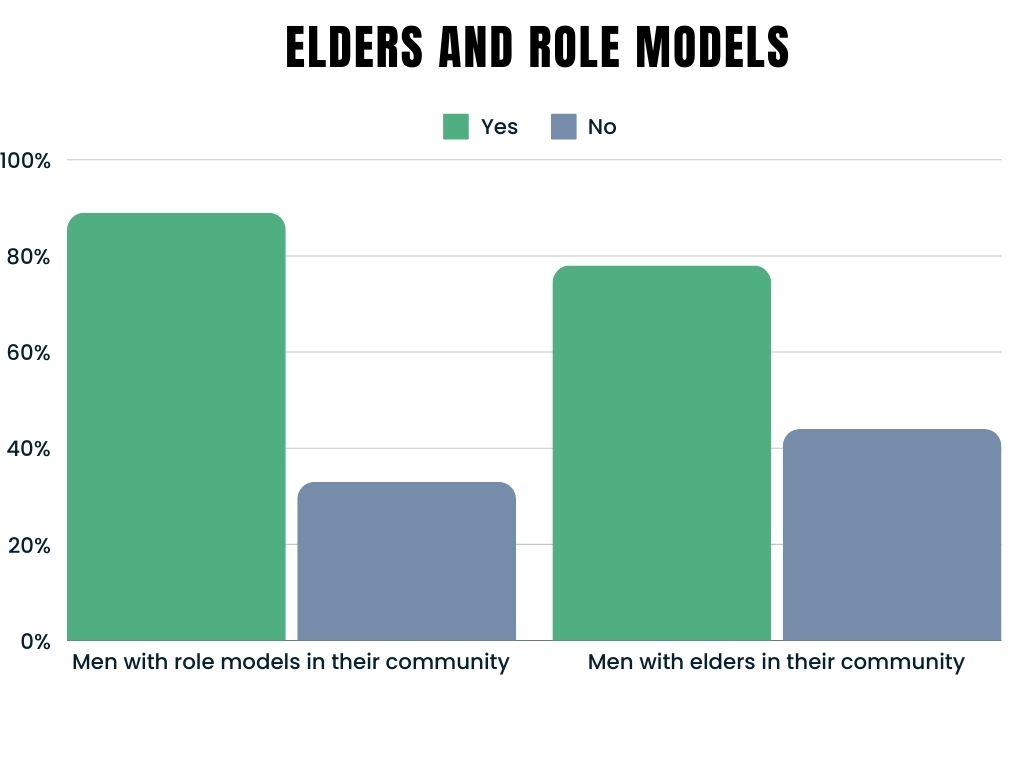
Men who practise mindfulness, seem to have found a way to connect with role models and elders.
In defining elders, ChatGPT says “Respected, often older, members who serve as leaders, guides, and custodians of wisdom and cultural knowledge. Elders are typically recognised for their life experience, understanding, and dedication to the community’s values, traditions, and well-being. They play a central role in passing down stories, beliefs, and cultural practices, often serving as mentors, advisors, and mediators in communal affairs.” Fair enough.
Both the elders and role models listed by the survey respondents reflected this definition, including parents and respected family members of both sexes, showing a deep psychological drive by these men to keep a sense of community alive.
Counterpoint received
Many of the comments received were in support of mindful practices and their results. However, the loudest commentary was the sheer silence from the many men who received the survey link – whether face-to-face or on social media. It’s just seems not to be in men’s realm of consciousness to consider mindfulness and meditation.
While there were many supportive comments, specific contrary views were received:
“…on how the ‘statement defines your view of masculinity’ I was unsure how to answer. The statements I can agree with or disagree with, but not sure how to link it to my view of masculinity? Are you asking if men view conflict as more a part of life in q7 for e.g.? Or if I as a man, view conflict as a part of life? I’m not sure if my answer would be different if I was a woman though…s o if I asked my wife, she’d probably say that conflict is a part of life too, hence I was unsure of how to interpret it.”
and
“I filled it in and i have to say I came across questions that felt ambiguous too… I personally did not find many of the questions relating to masculinity, in my case. I could not link the particular questions you asked to masculinity. I just don’t view myself through that prism. This made it hard to answer… I just don’t do things because I think things are manly. I don’t introspect from that angle. I do things because I either have to (around family) or because I want to. I cannot recall last time I did things or considered things because I thought it was manly or because that is what men do. Sorry to disappoint but, I just don’t operate this way.“
The first comment is notable for the repeated use of ‘unsure’ and ‘not sure’, the second comment also picks up on ambiguity. I find this reflective of many men who are searching for certainty and clarity, a black-and-white view on life. From a depth-psychotherapeutic view, maybe the feminine nature of holding uncertainty and ambiguity is placed on the women in their lives? The second comment shows me a man who views masculinity as a badge or flag to carry, like a sports team’s jersey. Is he seeing mindfulness as a lens through which to view masculinity, rather than as a beneficial practice?
Comparing this to the outcomes of men who practice mindfulness, there ambiguity appears to be more tolerated – although there is no guarantee! Further, the practice of mindfulness is not seen as a lens to view masculinity, but rather a practice that can bring a broader engagement with the world, connection to a community, and healthier choices in life.
Reset
This survey highlighted that benefits that can enhance the quality of life for men, including improvements in mental and physical health, relationships, work performance, and overall well-being.
However, it shows the distance between mindful practices and other competing activities these men are involved with. If taken into broader societal reflection (and including women) it might be indicative of the reactionary and inflammatory social and political environment the pervades the world today in the midst of a climate change crisis – although mindfulness is even more essential in these times.
Not that a naive view should be adopted – mindful practice is not a panacea to life’s ills, yet it opens the doorway into the heart of masculinity, allowing us to be more true to our inner needs, have greater resilience in adversity, enjoy more fulfilling intimate relationships, make conscious behavioural and consumptive choices, and benefit from a deeper, more authentic community with more attuned social intelligence.
“The practice is not to become enlightened in the future. The practice is full, vulnerable, intimate, open participation in our immediate experience, which is all we ever have anyway.”
Bruce Tift, Relaxing into Freedom
Leave a Reply